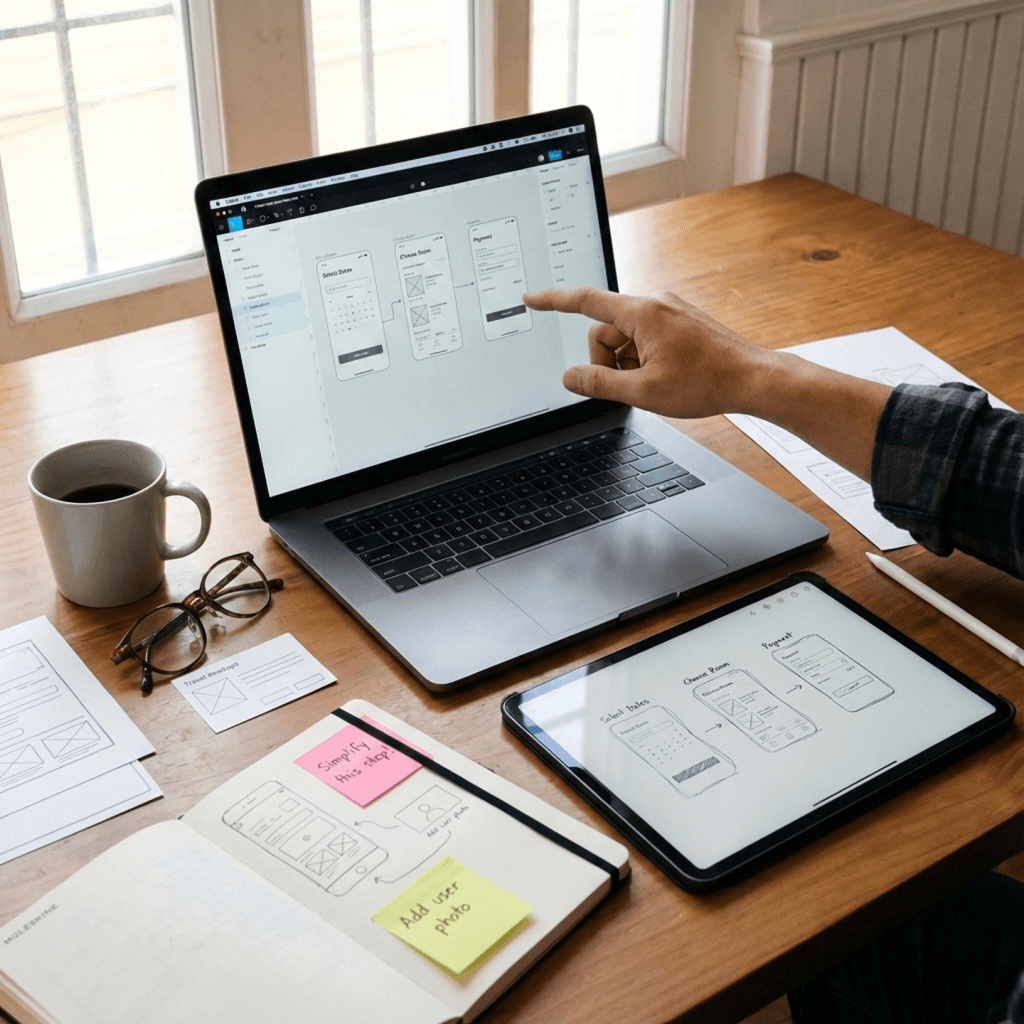
UI/UX design.
Interfaces that move users from curiosity to action. User flows, wireframes, prototypes, and production-ready design systems.
- 4-8 wkConcept to handoff
- 30+Components per system
- AA+Accessibility baseline
- 1:1Figma to prod parity
Capabilities
- 01User Flow and Funnel Design
- 02Booking and Checkout Optimization
- 03Wireframing and Prototyping
- 04Interface Design
- 05Usability Improvements
- 06Conversion Rate Optimization
- 07Responsive Design
- 08User Journey Mapping
- 09UX Audits
- 10Design System Consistency
Good UX is invisible work. Every screen earns its place by removing a step or clarifying a choice. We start from the user journey, not the screen inventory, so the design system serves the funnel rather than the other way around.
Wireframes and prototypes go through usability testing before any visual polish. The aesthetic decisions get made on top of a foundation that already works.
Design systems are delivered as reusable components paired with engineering documentation, so the build team isn't reverse-engineering the spec.
What you get
From research to production-ready files. You can hand the output to any engineering team and ship without rework.
- 01
User research synthesis
Interviews, usability testing, and analytics review distilled into a written brief. Decisions are traceable back to a person, not a guess.
- 02
User flows and wireframes
Every flow from entry to confirmation, mapped at the funnel level before the screen level. Wireframes go through usability testing before any visual polish lands.
- 03
Hi-fi UI and prototype
Production-fidelity Figma file with interactive prototype links. Stakeholders review the actual experience, not screenshots.
- 04
Design system and tokens
Reusable components with variants, semantic tokens for color, type, spacing, and motion, plus a documented contract for engineering.
- 05
Engineering handoff doc
Component-level notes, edge cases, motion specs, and accessibility annotations. No translation layer between your designer and your developer.
How we work
Five phases that prevent the usual rework cycles. Each one ends in a written checkpoint.
- Phase 01
Discover
We sit with your team, your data, and your users. Existing analytics, support tickets, and 5-8 user interviews are the floor.
- Phase 02
Define
Synthesised insights become a written design brief: success metrics, constraints, and the funnel we're optimising. Nothing gets designed without one.
- Phase 03
Design
Wireframes first, then UI. Fidelity rises only after the structure is validated. Single source of truth in Figma; no scattered files.
- Phase 04
Validate
Usability testing on the prototype with 5 representative users. We fix what breaks before engineering touches a line of code.
- Phase 05
Hand off
Tokens, components, and engineering notes shipped together. Optional implementation review: we sit with your devs to keep parity.
Built for
Honest about where we add the most value.
- 01
Founders pre-launch
- Fit
- You have product clarity but the surface needs to convert. We bring structure that survives the first 12 months of growth.
- Not a fit
- If you're still validating the problem, lean prototyping with your team beats hiring us.
- 02
Growth teams hitting a ceiling
- Fit
- Conversion is plateauing and the existing UI is the bottleneck. We rebuild the funnel, not just the screens.
- Not a fit
- Looking for visual refresh only? A studio that does brand-only work is the cleaner spend.
- 03
Engineering-led teams
- Fit
- You ship fast and design debt is showing. We slot into your repo conventions and component naming so the work merges cleanly.
- Not a fit
- Want a designer to disappear into a Figma cave for six weeks and emerge with a deck? That's not the model.
Engagement
Three shapes of engagement. We'll tell you up front which one matches your stage.
- 01
Design partner retainer
FormatMonthly
Embedded design capacity for ongoing product work. Weekly reviews, shared roadmap, and a steady delivery rhythm. Minimum 3 months.
- 02
Project sprint
Format4-8 weeks
Fixed-scope project: one product surface, one funnel, or one onboarding flow. Discover to ship in a contained window.
- 03
UX audit
FormatTwo weeks
Heuristic review and usability testing on an existing product. Written report with prioritised fixes, ranked by effort vs impact.
Featured projects
- 2026Odile Hotel
Brand, website, and copy for a seafront nature retreat in Çıralı, built to feel as unhurried as the place itself. Now the booking path belongs to them.
- 2024Pley
Visual identity, storytelling, UI UX design, and custom development built as one system.
- 2024Naturelife
UI UX improvements focused on booking flow, supported by a fast, reliable web build.
Common questions
Do you do research as part of the design process?
Yes. Interviews, usability tests, and analytics review are standard inputs. Research effort scales with the stakes of the decision.
What deliverables do you ship?
Figma files with components, variants, tokens, and engineering notes. Plus prototype links for stakeholder review and usability testing.
Can you work alongside our existing engineering team?
Often, yes. We'll match your component naming and token structure so the work merges cleanly into your existing system.
Do you work in our existing design system or build from scratch?
Either. If you have a system, we extend it and respect your token taxonomy. If you don't, we build one that engineering can adopt without retraining.
How do you handle accessibility?
WCAG 2.2 AA is our floor on every project. Color contrast, focus states, keyboard navigation, and ARIA labels are part of the spec, not an afterthought.
What software do you work in?
Figma is the source of truth: components, variants, tokens, and prototypes all live there. Engineering handoff includes Storybook references and code-level component contracts where they exist.
Design that ships, then keeps shipping.
Tell us about the product, the audience, and the metric you need to move. We'll come back with a scoped plan you can act on.